Productivity Bite: Higher U.S. Productivity Growth – AI Effects Are Likely, but It’s Too Early to Call It a Boom

In the United States, productivity growth – measured as output per hour worked – has been quite high over the past two years. Some observers argue that an AI-driven productivity boom is already visible.
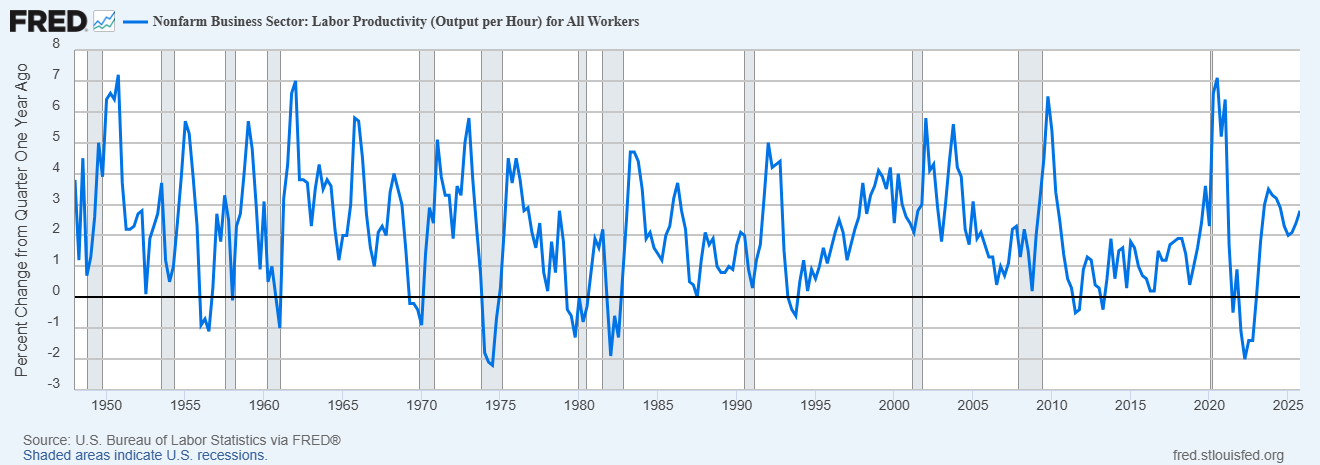
A look at the figures (Figure) suggests that caution is warranted when interpreting productivity growth. Quarterly growth is volatile and frequently influenced by one-off effects such as the pandemic. This means that higher productivity growth – even if it persists for several quarters – should not be hastily interpreted as a new trend.
What stands out is the prolonged period of very low productivity growth during the 2010s. For roughly two years now, productivity growth has indeed been higher than it was back then. It is quite possible that some productivity-enhancing effects of artificial intelligence are beginning to show. AI undoubtedly has this potential, and various studies – particularly at the microeconomic level – demonstrate this in sometimes striking ways. At the macroeconomic level, it is empirically more difficult to cleanly identify an AI effect. For instance, productivity gains in certain workplace tasks may lead people to spend more time on activities that are – from an economic perspective – less productive, such as an increase in bureaucracy.
One should also bear in mind that a significant portion of US economic growth in recent years has been driven by investment in data centers. These investments are capital-intensive and increase measured productivity growth. It is therefore possible that the AI boom is not yet manifesting so much as higher workplace productivity, but rather as substantial investment that is by its nature less labor-intensive and thus raises measured productivity.
It will be interesting, in the coming quarters and years, to compare developments in the United States with those in Europe. The US has historically adopted new technologies somewhat more quickly and intensively than Europe – for example from the mid-1990s onward. If this is again the case, one would expect the US to once again show a productivity lead in the years ahead.