
Productivity Bite: More Work, Same Prosperity?

Commentators frequently claim that in Switzerland, Germany, and other European countries people need to work more in order to maintain prosperity. These statements spark an interesting debate that is also relevant at the societal level. Work can be very rewarding and meaningful — although this is not true for every job. In addition, expertise is acquired through work. Nevertheless, it is an enormous achievement that we work fewer hours on average today than in the past. In the long run, prosperity cannot be created primarily through more work, but through new technologies and sensible political frameworks for economic activity, particularly for innovation. In addition, if our society aims at increasing incentives for having more children, requirements to work more can be counterproductive. Policy proposals that mainly resort to demands for more work are not entirely wrong, but appear helpless and lack any positive vision.
In various countries, there are undoubtedly misaligned incentives in tax or social welfare systems that can make working more financially unattractive in some cases. These misaligned incentives should be eliminated. It makes little sense to artificially create incentives that discourage work. Individual decisions are influenced and losses in prosperity occur at the societal level. It is also important to appreciate the positive aspects of work. A contribution is made to society, and work can be very meaningful in many — though not all — jobs.
Nevertheless, the demand “more work, same prosperity” misses the core of the problem. First of all, more work and less leisure fundamentally represent a loss of prosperity, insofar as the implication is that one must earn the same wage — or, at the macroeconomic level, the same GDP — through more work. More work is necessarily associated with a loss of prosperity if it does not increase economic output.
Gains in prosperity arise in the long run through higher productivity — working hours cannot be increased indefinitely in any case. Higher productivity is sometimes equated with more stress and a greater intensification of work. Yet higher productivity means precisely the opposite: that we can produce more goods and services without working more or experiencing more stress.
Higher productivity thus means making better use of new technologies or improving the organisation of teams, thereby increasing efficiency. Productivity growth has recently been only moderate in many advanced economies — particularly in Europe. There is still considerable room for improvement here.
Recently in Germany, the Joint Economic Forecast Project Group — comprising many of Germany’s most renowned economic research institutes — published a medium-term forecast for productive potential. According to their calculations, growth in total factor productivity in Germany, which measures these productivity advances at the macroeconomic level, is set to remain only marginally above zero percent in the coming years. This should not primarily be interpreted as a prediction of what will actually happen. The methods underlying these calculations are unreliable in times of structural upheaval and are influenced by current phases of stagnation or labor hoarding. Future productivity gains — from artificial intelligence, for example — cannot be predicted by such methods in any case. Nevertheless, these calculations are worrying. If Germany succeeds in achieving higher total factor productivity growth through greater innovation and structural reforms, this could partially or fully offset the projected decline in the volume of work. The consequences of an ageing population could thus also be cushioned.
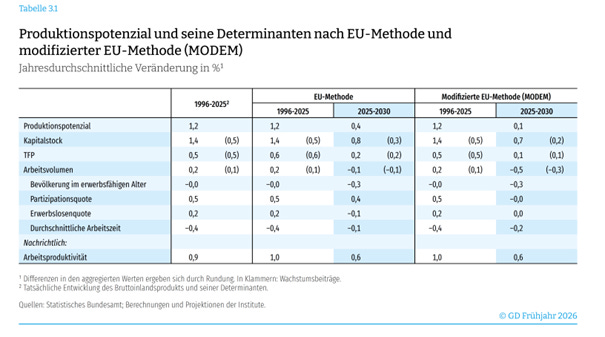
Looking to the past, we can consider a simple thought experiment for Switzerland: since 1980, productivity growth in Switzerland has been modest. Had productivity in Switzerland grown by just 0.1 percentage points more each year since 1980, we would today need around 250,000 fewer full-time positions to generate the same GDP. With somewhat stronger productivity growth, we could therefore have reduced our own working hours or achieved higher economic growth. Even higher productivity growth would have had the potential to reduce working hours even further.
Pursuing economic growth through higher productivity rather than “simply” more work is also important against the backdrop of declining birth rates. In a free society, having children should be an individual decision. However, there is much evidence that people on average want more children than they actually have. Alongside financial pressures, time resources play an important role in the decision to have children. From a societal perspective — particularly in light of an ageing population — there is a clear interest in not reducing birth rates further by making conditions more difficult. As mentioned, however, raising children entails a lot of unpaid work. Increasing parents’ working hours in their jobs is difficult to achieve for practical reasons — especially given that parents today often work more hours than in the traditional single-earner model of the past.
The key to greater prosperity, well-being, and more children is therefore not primarily more work, but higher productivity. A demand to maintain prosperity primarily through more work would effectively represent a capitulation of politics — an admission that it is unable to change the conditions needed for greater productivity growth. One should therefore always be prompted to reflect when the call for more work is heard from political circles or elsewhere. Instead of saying “more work, same prosperity,” the message should be: “the same amount of work, more prosperity.”